


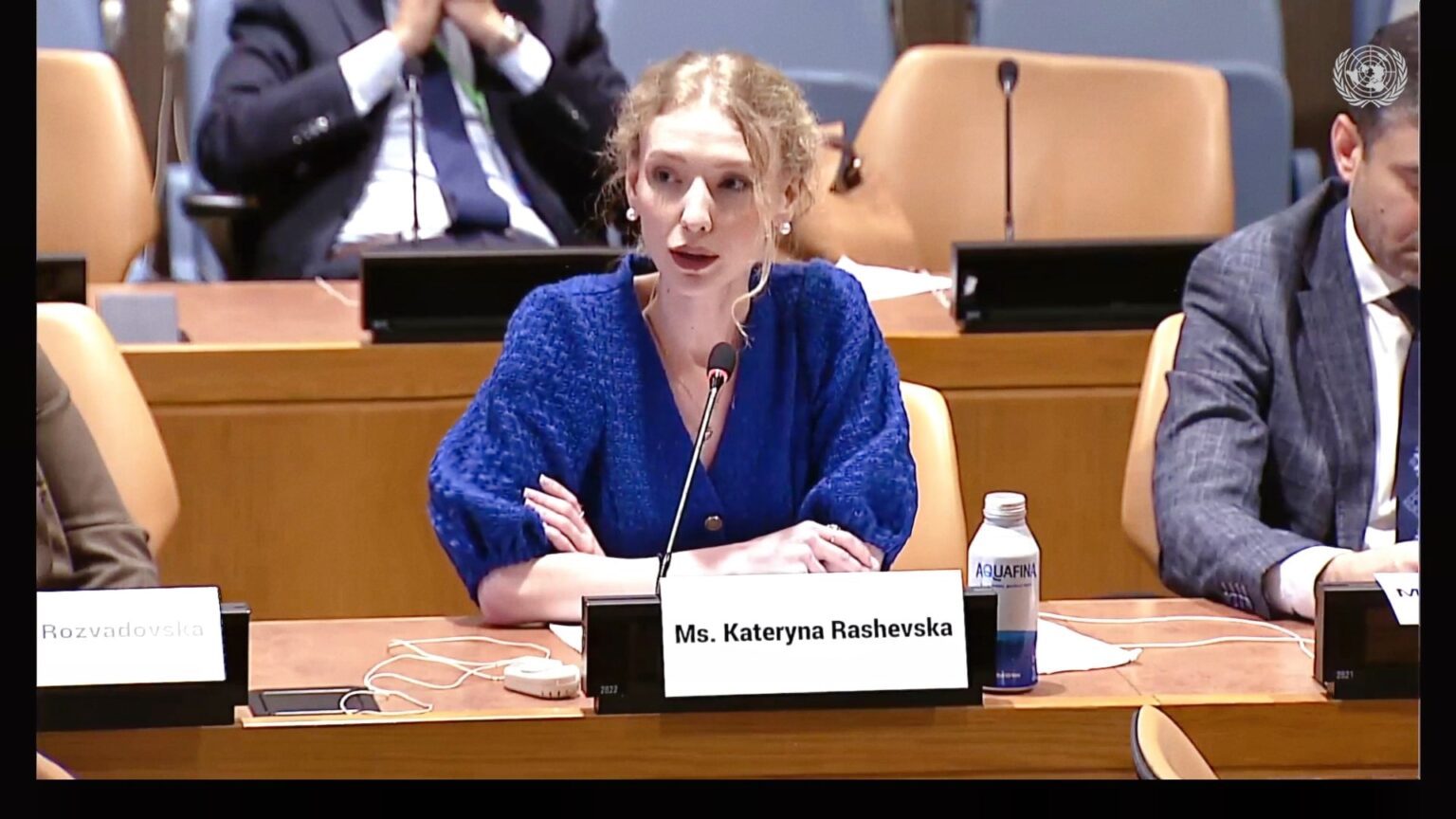
Fighting for the Future: Ukrainian Children in war
78th UNGA’s session
Briefing by Kateryna Rashevska
19 September 2023
Distinguished audience, ladies and gentlemen,
Today, I have the privilege to address this esteemed assembly to shed light on a deeply concerning matter that has captured the world’s attention and demands our collective efforts and resolve. These are the unlawful deportation and forcible transfer of Ukrainian children by Russian agents. The strength of the international community is measured by the well-being of our children. At the core of our responsibilities lies a fundamental commitment to their rights. We must recognize that this commitment to justice, human rights and international law is now being tested.
I am a legal expert at the Regional Center for Human Rights. In collaboration with the Lemkin Institute, my organization submitted a Communication to the International Criminal Court regarding the forcible transfer of Ukrainian children into the Russian national group. We also studied the imposition of Russian citizenship upon these children. Our findings concluded that if Russian high-ranking officials had acted solely for humanitarian reasons, they would have pursued legislative changes facilitating access to medical care, educational services, and social benefits, rather than amending the legislation to simplify the granting of Russian citizenship. Regrettably, this was not the case.
Today, in partnership with Save Ukraine, we are in the process of preparing a new Communication concerning the unjustifiable delay in repatriation of Ukrainian children. We consider this delay to be a distinct international crime. Our hope is that by bringing this matter to international attention, we can contribute to the safe return of our children to their homes.
To date, 19,546 Ukrainian children have been identified as deported or forcibly transferred by Russian agents. Only 386 children were returned. This was achieved through collaborative efforts between non-governmental organizations and Ukrainian state bodies, despite significant obstacles put in place by the Russian Federation. The existing repatriation schemes have proven to be of limited effectiveness and short duration. Furthermore, Russian agents have exploited the vulnerable position of children and their legal representatives. The Russian Federation has also refused to repatriate orphans and children deprived of parental care. At least 380 of them were forcibly transferred to Russian families. This situation poses a grave risk to the children, who could potentially become victims of other international crimes such as forcible mobilization or discriminatory persecution. In light of these challenges, there is an urgent need to develop and implement a unified mechanism for repatriation, rehabilitation, and (re)integration of Ukrainian children. And I call you to assist Ukraine with this important issue.
Unfortunately, it is not enough to talk the talk; we must also walk the walk.
The first step – Through joint diplomatic efforts to push the Russian Federation to fulfill its obligations in accordance with Article 78 of the Additional Protocol (I) to the Geneva Conventions and immediately provide comprehensive lists of the names and whereabouts of all Ukrainian children illegally deported or forcibly transferred by Russians.
Then, to adopt the Resolution of the UN General Assembly on international obligations in the field of repatriation of Ukrainian children, clearly establishing the requirements for Russia, Ukraine and the States Parties of the Geneva Conventions in accordance with Article 1 common to them.
On the basis of the adopted Resolution, we need to create a unique legal mechanism for the return of Ukrainian children by appointing a third party to mediate and monitor the signing and implementing a series of binding international treaties between Ukraine and the Russian Federation.
Finally, it is crucial to ensure the implementation of an individual approach in the activities of any agreed mechanism for the return of Ukrainian children, carrying out in each case an independent and impartial assessment of the best interests of the child, determined by the individual plan of return.
Ladies and gentlemen. In closing, let us not forget the grave injustices suffered by the innocent Ukrainian children torn from their homes, subjected to illegal deportation, and eradication of their national identity. The importance of repatriation cannot be overstated. It crosses borders and politics, reflecting our shared humanity. We have a moral and legal duty to ensure the safe return of Ukrainian children to their homes, as outlined in the concrete legal solutions I’ve presented.
Urge your governments, support international organizations, and stand in solidarity with Ukrainian children.