


UPHOLDING THE PRINCIPLES OF THE UN CHARTER: RESTORING JUSTICE FOR UKRAINE
78th UNGA’s session
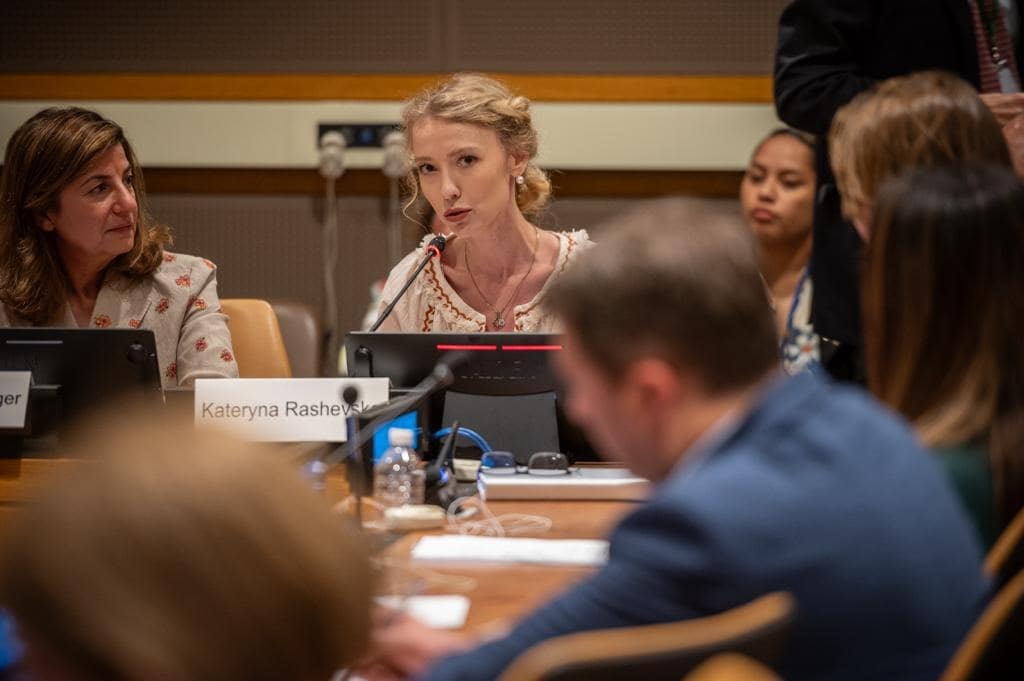
Briefing by Kateryna Rashevska
21 September 2023
Distinguished audience, ladies and gentlemen,
Thank you for having me there during an important week for the United Nations, an organization based on the principles of respect for sovereignty and territorial integrity; non-interference in internal affairs; equal rights; friendly relations; and cooperation in solving international problems.
The preamble of the UN Charter begins with the words “We the peoples of the United Nations determined to save succeeding generations from the scourge of war.” Unfortunately, the war that flitted from one region to another throughout the 20th century also reached my country, Ukraine. The brutal and unprovoked aggression of the Russian Federation, as recognized by 143 UN member states, brings only suffering and destruction. The first victims of this armed conflict are civilians: women, children, elderly persons, people with disabilities, as well as hundreds of thousands of men who were forced to take up arms and leave their peaceful lives, their jobs, and homes to prevent the onset of a global conflict. They stand for the values of the United Nations as passionately as we do in this room today. However, the armed conflict is ongoing and accompanied by numerous international crimes.
To date, more than 108,000 criminal proceedings have been initiated regarding the commission of war crimes by Russian agents in Ukraine. These are not sporadic consequences of war, these are patterns of widescale violations including wilful killings, unlawful confinement, torture, rape and other sexual violence, unlawful transfers and deportations of protected persons, including children. Many of these violations amount to crimes against humanity, such as the use of torture and attacks on the civilian infrastructure, which Russia is preparing to continue these autumn and winter, leaving first of all the civilian population to suffer. Tonight, the Russians once again launched 36 cruise missiles at peaceful, sleeping cities.
Article 5 of the UN General Assembly Resolution 3314 provides that “Aggression gives rise to international responsibility.” The impunity of persons and entities who commit international crimes or internationally wrongful acts makes it impossible to achieve the objectives of justice, not to mention peace and security. In the Preamble to the Rome Statute the States Parties of the International Criminal Court recognized that war crimes, crimes against humanity, genocide, and aggression are the gravest crimes that threaten the peace and security of all humankind and that therefore must not go unpunished, since the punishment of persons concerned will contribute to the prevention of such crimes in the future. The guilty persons are not only Vladimir Putin or Maria Lvova-Belova, against whom arrest warrants were issued on March 17. These are thousands of criminals at various levels who implement a large-scale and systematic policy of suppressing the resistance of Ukrainians through physical extermination, deportations, and discriminatory persecution.
I am a legal expert at the Regional Center for Human Rights. In collaboration with the Lemkin Institute, my organization submitted a Communication to the International Criminal Court regarding the forcible transfer of Ukrainian children into the Russian national group. We also studied the imposition of Russian citizenship upon these children. Now we are in the process of preparing a new Communication concerning the unjustifiable delay in repatriation of Ukrainian children. We consider this delay to be a distinct international crime. Our hope is that by bringing this matter to international attention, we can contribute to the safe return of our children to their homes, despite significant obstacles put in place by the Russian Federation.
Finally, what is justice for the victims of international crimes committed by Russian agents? Sure, it is impossible to imagine ensuring the right to justice and the right to the truth without accountability processes at the international level in existing bodies and in those to be created, such as the Special Tribunal for Aggression. However, I would like to emphasize that the implementation of the victim’s right to fair compensation is no less important than efforts to punish the perpetrators. One of the strategic goals that will have a long-term impact on peace-building processes in Ukraine is the establishment of comprehensive reparations programs, distinguished from, but also coordinated with national reconstruction programs, and property restitution and repair programs. They should be designed in close consultation with the victims and based on a victim-centric approach. If an international crime, according to the judgment of the Nuremberg Tribunal, is committed by individuals and not by abstract entities, then the victims, after all, are also individuals needed to be treated as subjects, not objects of the justice restoration process.
Nowadays, the attitude towards the victims of armed conflicts is an indicator of the development of the international community. Its development will never be sustainable if conflicts initiated by unpunished aggressors rage in various regions, including Ukraine.