


Ukrainian information space, exhausted and overwhelmed by war, was easy to get bypassed by this nearly televisional detective story from the Greek cultural heritage world which also has something to do with us. Now we will try to explain why.
On the 16th of September 2023, “Attica Security Office” in Greece held a great operation that blocked an attempt to sell cultural heritage of unlawful origin.
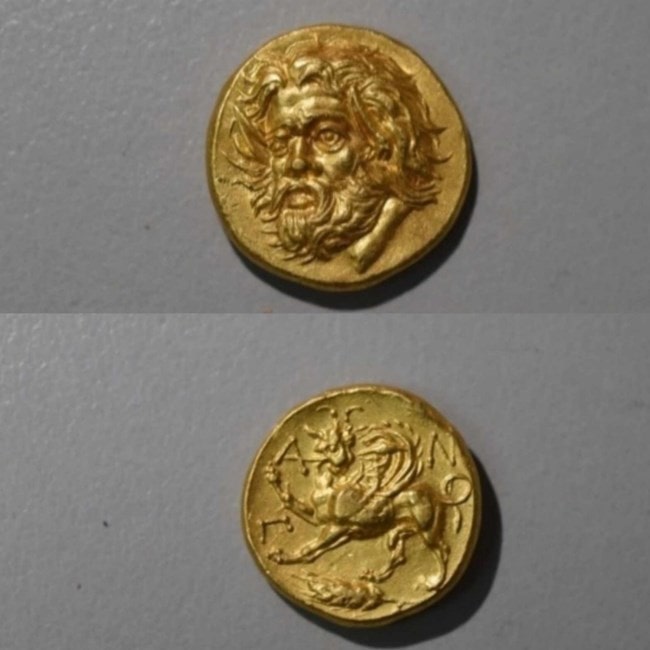
Among all the eliminated property was a “rare golden coin” – a golden stater of Pantikapaion.
The ancient city of Pantikapaion was a Greek colony on the Taurida Peninsula of the Black Sea (old name for the Crimean Peninsula). The coin dates to the IV century BC. The rarity of this coin is considered, due to the “Pan” (a Greek deity) depicted on it, particularly, due to his position on the coin, which is frontal rather than in profile. The value of this coin is estimated at $6 million.
This is the way the Agency of the Protection of Cultural Property works in European countries where laws are more stringent than Ukrainian, but there is no existing mechanism for their violations, and we truly hope one day it works this way in our country.
Greek experts that were mentioned in the article(1) in their turn have no doubt of the Ukrainian, particularly Crimeam, origin of the coin.
To be fair, the protection of the Ukrainian cultural heritage was in a critical, if not catastrophic position even before the Russian aggression. Regular flow of archeological discoveries outside Ukraine continues to lead straight to the dark markets through the different e-auctions and is being fueled by so-called “dark archeology”.
Before 2014 we could say that the stater appeared to be in private collections as a result of the activity of “dark archeologists”, but from the beginning of the Russian aggression another unsanctioned flow of cultural heritage appeared, and it is the activity of the Russian Federation.
Appropriation of the cultural heritage of colonies is a typical policy that was used by metropoles from the XIX – to the beginning of the XX century. Although Russia continued performing this policy throughout the XX century and continues doing it up to now. But here is the deal: Russia performs these actions on the occupied and annexed Crimean Peninsula during an armed conflict with a sovereign state which Ukraine is.
To define the way Ukrainian authorities, law enforcement agencies and society should react to the actions of the aggressor country, there is a need to understand the scope and the nature of the challenges.
Those institutions under the control of the Russian Federation are conducting hundreds of archeological excavations and seizing hundreds of thousands of pieces of Ukrainian cultural heritage per year. Moreover, just a fact of such activity is used by Russia in its propaganda.
After an occupation of the Crimean Peninsula in 2014 Vladimir Putin in his speeches empathized with the “sacred significance of Crimea” and Chersonese became “a place where the basis of the Russian nation was formed”. These narratives immediately take their place in propaganda and are actively being spread. Multiple Russian news agencies regularly post articles and films about Chersonese using headings, such as: “Chersonese. A homeland of our homeland” and “Where does Russia start”. Development of these materials is a merit of the Russian scientific and cultural community including staff of the State Hermitage and Institute of Archeology RAS (Russian Academy of Science).
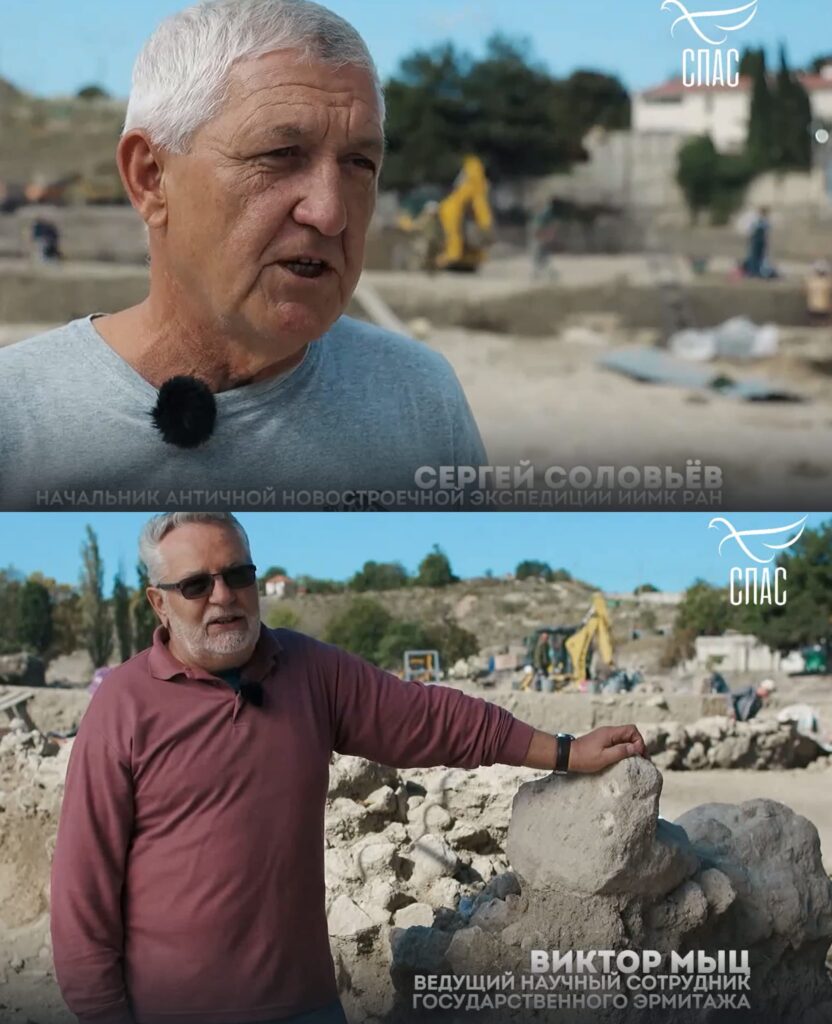
While Russian archeologist Andrey Sazanov in his interview for a magazine called “Historical Expertise” says that “the archeology ends where the borders and politics appear”, developing his idea of “archeology without politics”, his colleagues Sergey Solovyov and Viktor Myts are being filmed in a project for a TV channel “Spas” called “Chersonese. A homeland of our homeland”. In this film Russians try to appropriate not just items of archeology, but historical figures, particularly Kyiv Grand Dukes Volodymyr the Great, Svyatoslav the Brave and Grand Duchess Olha and use the fact of archeological excavation and stolen property as evidence of the authenticity of the shown picture.
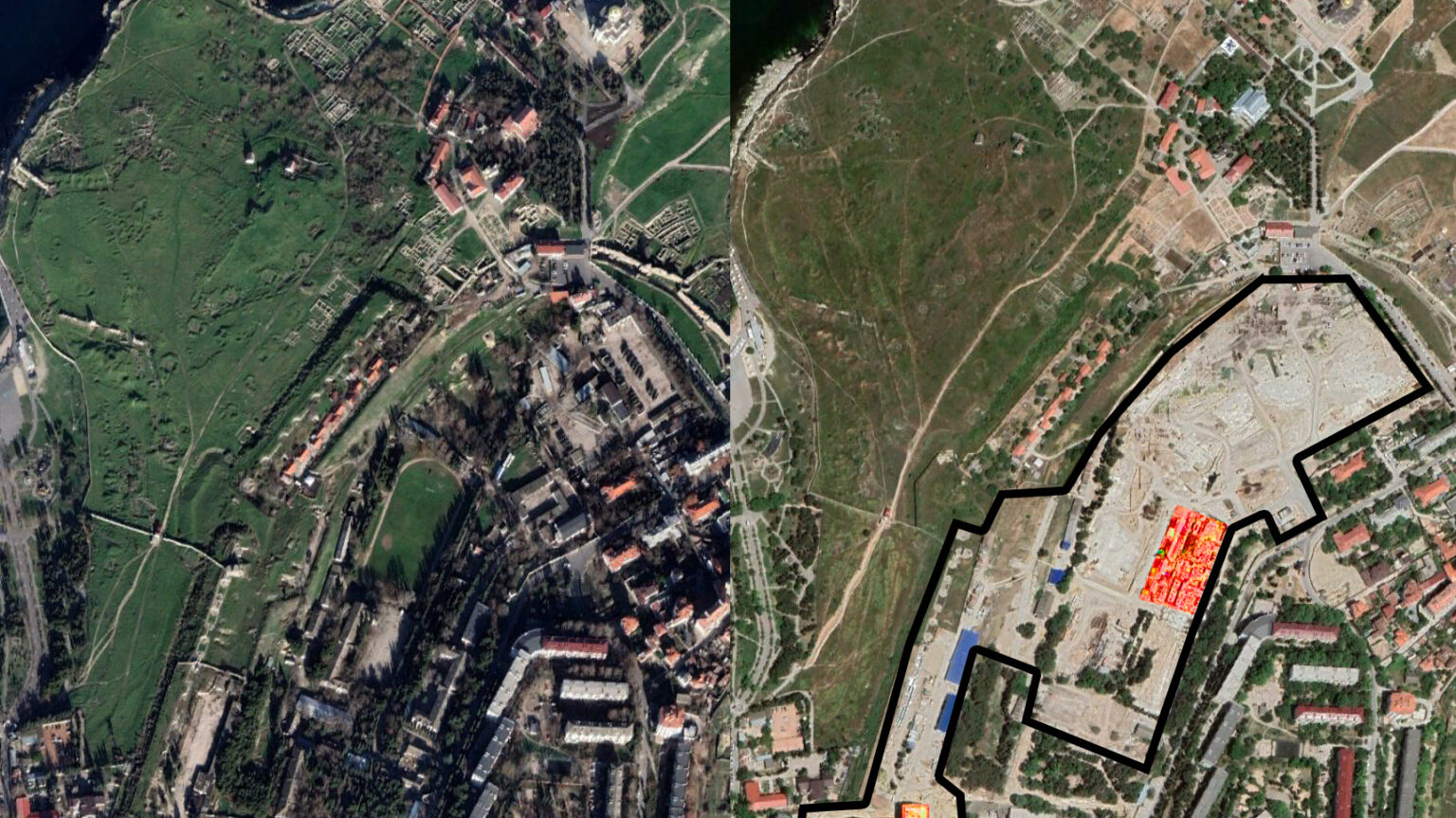
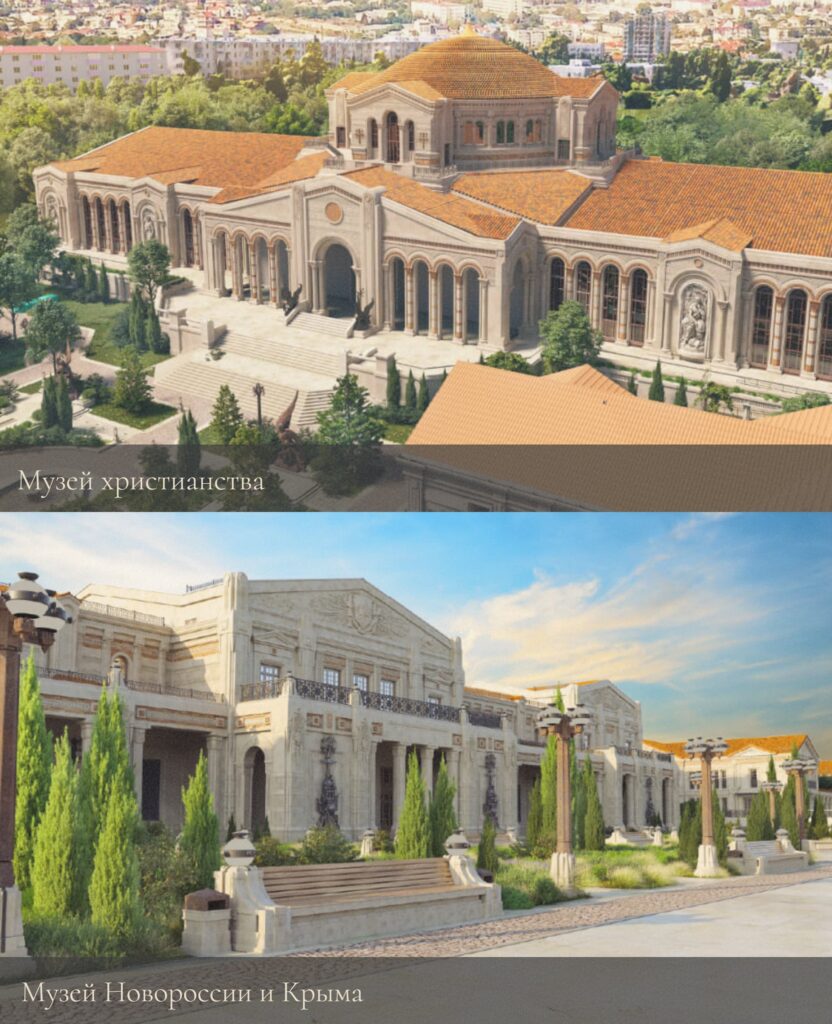
Vladimir Putin’s summit with Russian “culture figures” at the beginning of the war in 2014 was a platform for the articulation of the idea of creating a historical park “Chersonese”. Currently occupation administration of the reserve “Chersonese” issued a draft design of the new historical park with a complex consisting of “The Museum of Christianity”, “Museum of Novorussia and Crimea”, “Pilgrimage Centre”, “Temple Park”, and “Amphitheater” in a pseudo-historical style, using elements styled as medieval Byzantine right on the area of an antique monument of architecture – an ancient city of Thauric Chersonese, an object of UNESCO World Heritage List.
As of today, work is underway for the construction in the area of protection of the cultural layer. Russian occupants are destroying the monument of dozens of acres of territory under the guise of “excavation of the century”, stealing thousands of artifacts.
In the conditions of the inability to a balanced economic development of the Crimean Peninsula due to its isolation caused by sanctions, the occupation country invests huge amounts of costs from the Federal budget, allocating it for large projects which are of no use for the economic growth of Crimea. The main aim of such investments is the propaganda and military meaning of these projects, and archaeological monuments become victims of these goals.
Along the so-called “Tavrida highway” Russians themselves record at least 63 episodes of monument destruction. Most archeological works were held during one season under pressure from the Russian authorities because of the essential importance of the project, so the issue of preserving cultural heritage was not the priority of these works.
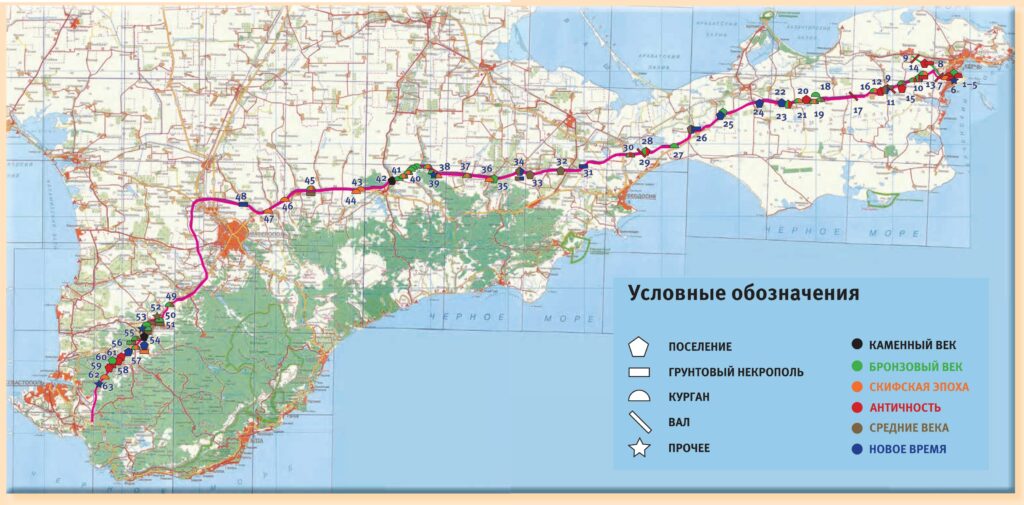
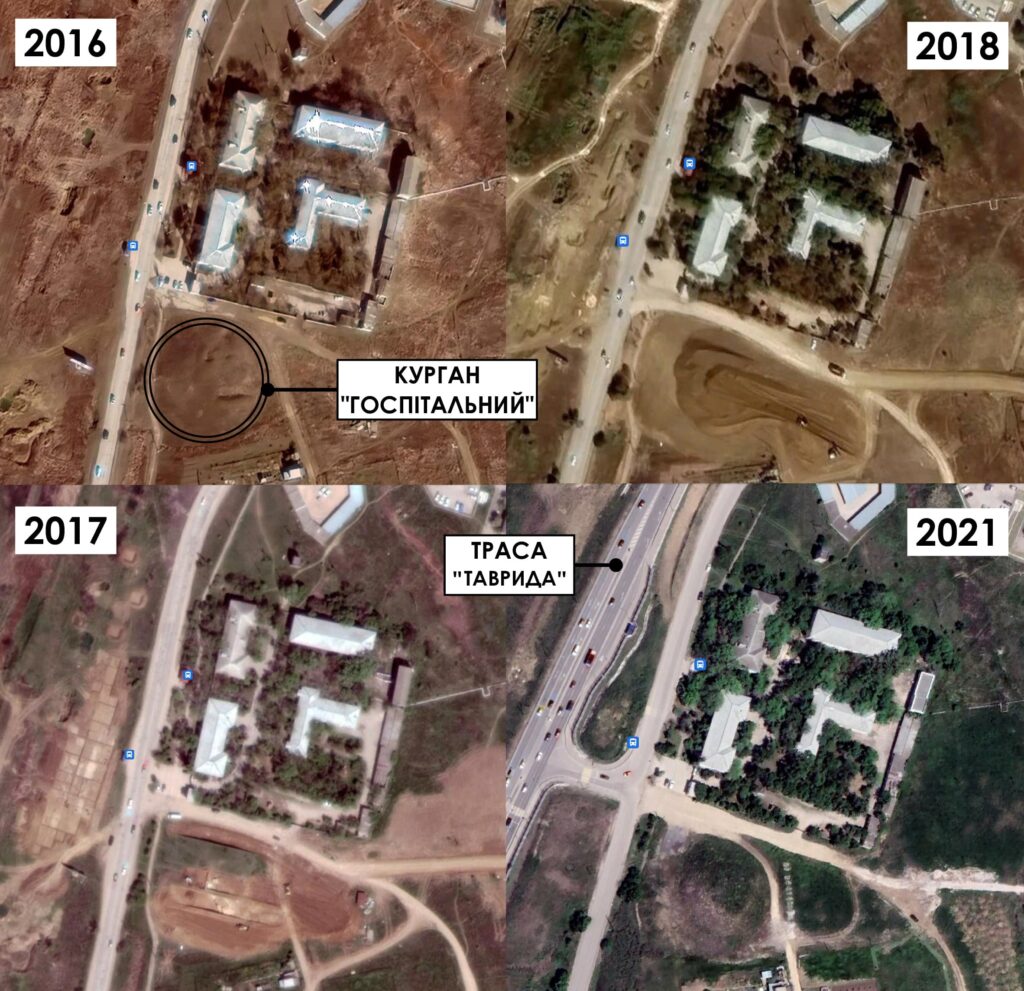
The number 63 is known to us from the Russian sources, we cannot be sure about the real number of cultural layers destroyed as it is impossible to establish. But the most cynical thing in the story is that the Russian Federation for its propaganda purposes presents those excavations that could remain untouched due to its remote location from the construction area. A perfect example of such works is Hospital mound, the territory of which wouldn’t have been used during the construction, although it was completely excavated.
As a result, the Hospital mound is completely destroyed and cannot be considered as a monument of archeology, but the Institution of Archeology RAS in its numerous publications written by Irina Rukavishnikova and Sergey Vnukov call these destructive works “rescue archeology”.
The activity of the Russian scientists on the territory of Ukraine just like Russian propaganda TV and other elements of the aggression that used to be within the legal framework of Ukraine appeared as something normal and clear before the Russian aggression in 2014.
It becomes obvious that this activity is a part of a massive aggression, hybrid originally, now it is an undisguised appropriation policy of the scientific knowledge about cultural heritage, and deprivation of the right to a cultural property and historic memory оf Ukraine both as a country and as nations that inhabit it.
During the Russian aggression, we faced not only the problem of returning the annexed territory but the returning of the stolen cultural property to Ukraine.
The Prosecutor’s office of the Autonomous Republic of Crimea has launched dozens of criminal cases on the fact of destruction of the monuments of culture by this and many other episodes of unlawful excavations.
Ukrainian investigators have an opportunity to create a mechanism for the investigations of the crimes against cultural property. These proceedings might become a first step for the formation of a permanent state policy for the protection of cultural property and restoring cultural justice.
Ukraine as a state has to overcome the reflection on the threat to the cultural property, caused by Russian aggression, and move to the formation and implementation of a consistent policy for the return of the cultural property, the key principles of which must become digitalization of the registry of the cultural property and mechanisms of its filling, documentation of the property losses, recording the facts of the crimes, identification of those involved in the crimes and systematic investigation that should be a part of a lawsuit on the international level.
Andriy Lutsyk
Cultural heritage protection expert NGO Regional Center for Human Rights
Sources:
- https://www.thetoc.gr/koinwnia/article/paraligo-ntil-ekatommurion-me-arxaiokapilous-exo-apo-to-tae-kbon-nto-o-tzoni-kai-to-spanio-nomisma-apo-tin-krimaia/
- https://www.dw.com/ru/%D1%81%D0%BA%D0%BE%D0%BB%D1%8C%D0%BA%D0%BE-%D1%81%D1%82%D0%BE%D0%B8%D1%82-%D0%BA%D1%80%D1%8B%D0%BC-%D0%BC%D0%BE%D0%B6%D0%B5%D1%82-%D0%BB%D0%B8-%D1%80%D0%BE%D1%81%D1%81%D0%B8%D1%8F-%D0%BF%D0%BE%D0%B7%D0%B2%D0%BE%D0%BB%D0%B8%D1%82%D1%8C-%D1%81%D0%B5%D0%B1%D0%B5-%D0%BD%D0%BE%D0%B2%D1%8B%D0%B9-%D1%80%D0%B5%D0%B3%D0%B8%D0%BE%D0%BD/a-17498469
- http://kremlin.ru/events/president/news/46453
- https://ria.ru/20230710/chersonesus-1873381346.html
This publication was prepared with the support of the Department of Technical Assistance To Ukrainian Law Enforcement Agencies of the US Embassy in Ukraine. The views expressed in this publication are solely those of the authors and may not necessarily reflect the position of the US Embassy.