


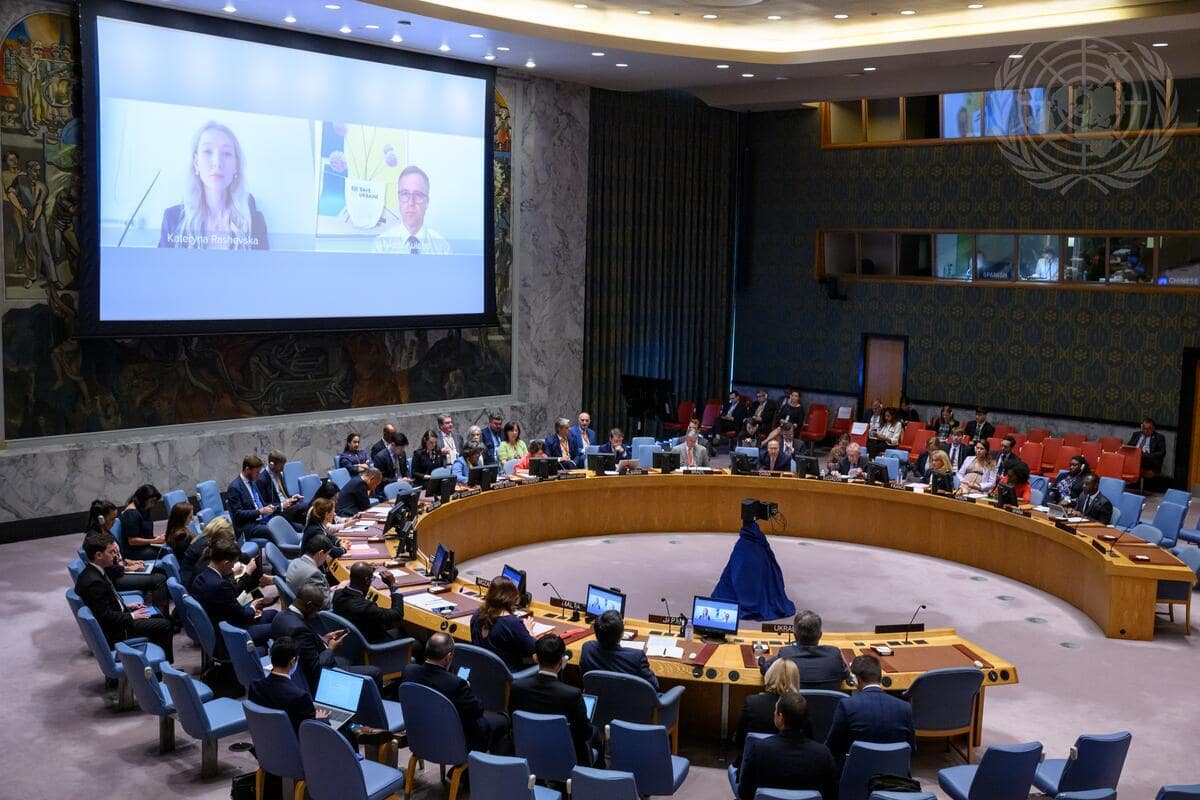
MAINTENANCE OF PEACE AND SECURITY OF UKRAINE –
Security Council, 9404th meeting
Briefing by Kateryna Rashevska
24 August 2023
Madam President, Your Excellencies, Ladies and Gentlemen,
I would like to thank the U.S. Mission for inviting me to address the Council today on the issue of unlawful deportation and forcible transfer of Ukrainian children. I am honored to be included among such a distinguished audience. My goal and objective is the pursuit of a solid solution to the crisis affecting Ukrainian children. It is based on the best interests of the child, and I ask you, the Security Council, for help.
According to the rapporteurs for the OSCE’s Third Moscow Mechanism, before Russia’s full-scale invasion, more than 1,000 children were displaced from Crimea to the Russian Federation for adoption[1]. According to the Ukrainian National Information Bureau, since February 18, 2022, Russian agents have taken at least 19,546 children from Ukraine[2] to 57 regions of the Russian Federation[3]. Among these children, 3,855 are orphans and children deprived of parental care[4]. The Russian authorities claim that this displacement is an evacuation. However, it is a violation of Article 49 of the fourth Geneva Convention and a war crime. Russia deliberately created the conditions for such a transfer of children, publicly intending to keep these children under Russian influence forever, and refuse to transfer the list of evacuated children to the Central Tracing Agency of the ICRC. These considerations formed the basis of the decision of the International Criminal Court’s Pre-Trial Chamber II to issue arrest warrants against President Vladimir Putin and Commissioner Maria Lvova-Belova.
Unlawful deportation and forcible transfer are not the only serious violations suffered by Ukrainian children. I would like to draw your attention to the imposition of Russian citizenship on Ukrainian children because the right to preserve one’s identity is a prerequisite for exercising all human rights for children.
Russian authorities claim that the imposition of Russian citizenship on Ukrainian children is strictly a humanitarian action. But legislative changes made by the Russian authorities to facilitate this as well as the treatment of Ukrainian children who have had Russian citizenship imposed on them do not back up this claim.
Following a detailed analysis of Russian legislation on citizenship[5], it is clear that if high-ranking officials of the Russian Federation intended to act solely for humanitarian reasons, then, instead of amendments to legislation for the simplified imposition of Russian citizenship, laws would have been adopted to facilitate obtaining medical care as well as removing obstacles to education and social benefits. But this is not the case.
It is worth emphasizing that, despite the declarations, Ukrainian children are recognized exclusively as Russian citizens in relations with Russia. There is no dual citizenship agreement between Ukraine and the Russian Federation. Therefore, upon reaching the age of majority, Ukrainian boys will be obliged to fulfill their duty under the Constitution of the Russian Federation – to serve in its armed forces. At least 43 cases of enrollment of Ukrainian children in cadet classes[6] where they are turned into enemies of Ukraine are known now. Such actions may have the elements of a war crime.
Russian citizenship is needed mainly to simplify the transfer of Ukrainian children to Russian families, as was discussed during a broadcast meeting on March 9, 2022, in the Kremlin. According to the statements of Commissioner Lvova-Belova, there are already 380 such children. However, the process is ongoing. In this context, while agreeing that the known cases of transfer were, indeed, guardianship, I want to emphasize that raising these children by Russian citizens, as well as political indoctrination, Russification, and militarization in the education system, which the Ukrainian children are obliged to receive, is a violation of several articles of the United Nations Convention on the Rights of the Child at once, and also have elements of discriminatory persecution. As explained by a Venezuelan diplomat in the original United Nations Sixth Committee debates on the Genocide Convention, the forcible transfer of children to a group where they would be given an education different from that of their own group, and would have new customs, a new religion and probably a new language, was in practice tantamount to the destruction of their group, whose future depended on that generation of children.
Although school education is mandatory in most countries, Russia, as an occupying power, must provide Ukrainian children with access to Ukrainian education. Instead, they are forbidden to speak and learn the Ukrainian language, to attend Ukrainian schools online, to preserve and manifest their Ukrainian identity. I want to emphasize that for six years, Russia has not implemented the order of the International Court of Justice to ensure the right to education in Ukrainian and Crimean Tatar languages in Crimea. The weak enforcement of this decision led to the repetition of the violation in the newly occupied territories.
The so-called re-education takes place not only in schools. Earlier this year, the Yale School of Public Health demonstrated how recreation camps are involved in this process. In 2023, we have already recorded the transfer of at least 7,116 children – to 46 camps in the Russian Federation, seven camps – in occupied Crimea[7], and four camps in Belarus[8]. Some facilities are 9,000 kilometers away from the children’s original homes. Others are located not far from military facilities. Due to the lack of access to these territories, confirming or denying the return of Ukrainian children home is impossible.
However, it is known what difficulties the legal representatives face during the return of children displaced starting in 2022. These are additional checks at the border, long-term interrogations by representatives of Russian law enforcement agencies, the requirement to obtain Russian citizenship and to reissue guardianship documents according to Russian legislation, forced nudity, and the polygraph examination. A relative of 17-year-old Denys was deported from Russia without explanation and without Denys. 17-year-old Bogdan was detained at the border and again transferred to a Russian foster family. I call on the Russian Federation to facilitate the return of Bogdan and Denys to Ukraine.
Currently, only 386 children have been returned[9]. Today I am addressing you with a clear call: to assist in the return of the Ukrainian children. The obligation of immediate and unconditional repatriation is universally recognized. The relevant article of Additional Protocol I to the Geneva Conventions was adopted by consensus. We need the UNGA resolution, which will define the obligations of each member of the international community in returning Ukrainian children. This should be a transparent process between Ukraine and Russia by appointing a third-party guarantor and concluding an international binding agreement. Leaving Ukrainian children in Russia means continuing to violate their rights.
Excellencies, ladies and gentlemen: This is your moment. It is your time to demonstrate commitment to international law and the best interests of the child. Help children go back to their normal lives, as Ukrainian children in Russia never can.
[1] https://www.osce.org/files/f/documents/7/7/542751.pdf?fbclid=IwAR0RxUefyN2PKd7uVBgZnbwWZBLIldtZfoZRP_qVeBeNkjUI7bH5qayYDt8
[2] https://childrenofwar.gov.ua/
[3] https://docs.google.com/document/d/1YzlLsandGTZVKvkh15-xUPt0IqtJMWf6hoa4dIjPGKM/edit?usp=sharing
[4] https://drive.google.com/file/d/117a_Tu7ak5AQooUSu1eaAejmqH66Da3R/view?usp=sharing
[5] https://www.lemkininstitute.com/ukraineproject/icc-communication
[6] https://web.archive.org/web/20230809134800/https://pressa.sledcom.ru/ZHurnal/Magazine-3-2023/item/1809039/
[7] Information is available upon request to the Regional Center for Human Rights
[8] https://krymbezpravil.org.ua/en/analytics-en/legal-assessment-of-the-displacement-of-ukrainian-children-to-belarus_-the-evolution-of-an-international-crime/?fbclid=IwAR2RwZcjeiWTjrUMWBINLvvLR4_zZ5QovvMOyYQLJDWfkTU9c1h1X2GDO7g